Extending STEM Core Subject Topics into ExploraVision Projects
By Jasmine Jones, Skyline High School, Dallas, TX
Toshiba/NSTA ExploraVision is a great opportunity to engage students in scientific research, the engineering design process, and plan an experimental design to test an original product. Many teachers may feel they need a special course that allows a timetable to dedicate just to skill building and engaging students in the project over a structured amount of class time. Many innovative solutions and problem ideas can come straight from the core STEM subject curriculum, such as application of how biomolecules are used in everyday live or how genes are being engineered or regulated to solve problems.
The future innovators of the world are inquirers and designers who are looking for the chance to apply what they are learning every day into the real world and do something meaningful with the knowledge they are developing. You will be surprised what students will come up with when prompted to research and question their community and apply what they are already engaged in.
Skyline High School has participated in the ExploraVision competition for three years. In the first year (2022-2023), one team was awarded honorable mentions. In the second year (2023-2024) four teams were awarded honorable mentions. In the third year (2024-2025), we had our first regional winning team and an honorable mention winning team. We challenged our students to extend their core science knowledge by researching problems of interest. This year our regional winners researched how photosensitive epilepsy affects the eye, how seizures affect the sensory system, and current solutions to the issue. The team then proceeded to use the lab skills attained in class to design an improved solution, prototype a design, and test their prototype to determine expected results.
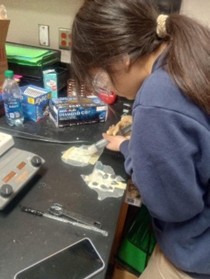
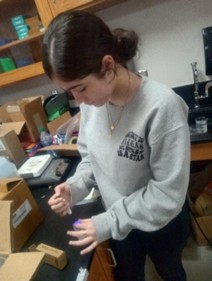

We supplemented our curriculum with some free high school engineering design resources we attained from Engineering Tomorrow to teach students to CAD draft for 3D printing and free resources from Lemelson-MIT Jr. InvenTeams to prototype bioplastic materials.
Students were willing to do homework and continue to work on the projects outside of class to maintain the core course pacing when they felt the work was helping them get more in depth with something they found interesting.
To learn more about the 2025-26 ExploraVision program, visit https://www.exploravision.org.
This blog explains how Toshiba ExploraVision helps students connect core classroom STEM lessons to real-world project development. Educators can guide learners to expand science, technology, engineering, and math concepts into ExploraVision national science competition entries by exploring current technologies, asking deeper questions, and applying research skills. The piece highlights practical ways to turn classroom topics into innovative project ideas, encouraging teamwork, critical thinking, and creative problem-solving. By integrating standard STEM curricula with hands-on exploration and future technology envisioning, ExploraVision empowers students to strengthen understanding, improve communication skills, and succeed in national and regional STEM competition.