Tomorrow's Innovation Comes From Today's Young Minds. Exploravision Awards 2010

Student Resources

Brainstorming / Choosing a Topic / Research

Brainstorming

Brainstorming is a helpful and fun way to think of creative solutions to a problem. The theory is that by coming up with as many ideas as possible and not limiting your thinking, you'll discover new, unusual and creative ideas.

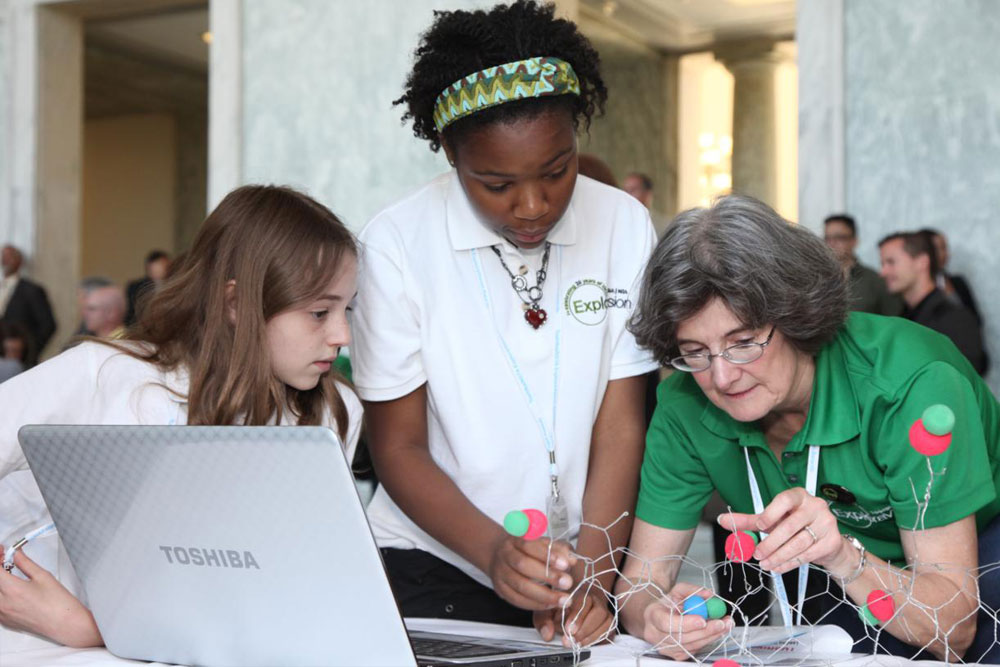
Brainstorming tends to work better with a group of three to six people. Someone should be the leader, and someone (it can be the same person) should be the recorder. The recorder is in charge of writing all the ideas down where everyone can see them on a white board, chalkboard or big flip pad.

  1. Define the question. Before you start, everyone should agree on the problem you are trying to solve. Start with a question that's not too broad — you can always have additional brainstorming sessions. As a group, you might pick a word or words to fill in the blanks of the following questions to start your brainstorming session.
    • "What is an imaginary new product that could help______?"
    • "How will ______ be improved in the year 3000?"
    • "If you could make the perfect ______, what would it do?"
    • "What if we combined _____ and ______?"
  2. Watch the clock. Give yourself a set time limit for coming up with ideas. Fifteen to twenty minutes is probably ideal. On your mark, get set, go!.
  3. Write down every idea. One the brainstorming starts, participants shout out ideas as they come to mind. Don't limit yourself — one of the keys to successful brainstorming is the acceptance of EVERY idea — even those that seem silly or impossible. No one is allowed to criticize or limit any of the ideas during the brainstorming session, because you never know where the next great inspiration is going to come from!
  4. Evaluate. After time is up, the group should talk about which ideas are favorites and why certain ones would work better than others. As a group, vote on which idea you like best!

CALENDAR

Learn a little about science and keep track of key dates for the Exploravision Awards.

Color Key

  • Cool moments in science history
  • ExploraVision key dates
  • Current events in science

Key Dates

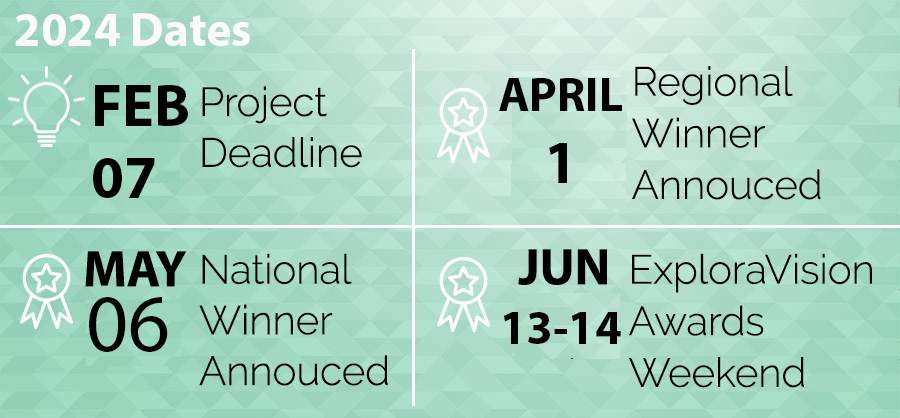
  1. Feb 2

    Entry Deadline
  2. Feb 26

    Regional Winners Announced
  3. Apr 30

    National Winners Announced
  4. Jun 9 – 13

    ExploraVision Awards Weekend

A Word From Our Alumni

"The friendships you develop, teamwork on which you depend, and the critical thinking skills you're taught cannot be paralleled anywhere else at that time of your life."
Rhodes
University of Virginia
1993 Award Winner