National Science Competition Winners | Toshiba ExploraVision
bulbAsset 2Coffeeemailfacebook-dsdVector Smart Objectemailhandsinstagram-dsadaketchun-logolinkedin-dasdasquote-startVector Smart Object1searchtrophy2Asset 2twitter-dsadafacebook

ExploraVison National Science Competition Winners

Select

SHARE

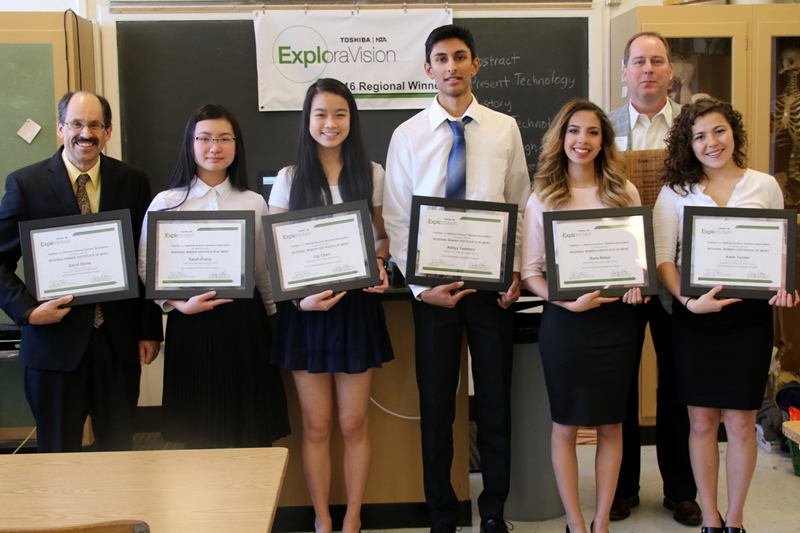
1st place

Back: Kennedy Cross (Toshiba), Front: David Stone (Coach),Sarah Zhang,Joy Chen, Aditya Yedetore, Rima Rebei, Katie Tender (Mentor)
University Laboratory High School – Urbana, IL

BEISight: Bionic Eye Implant for Sight

The Bionic Eye Implant for Sight ( BEISight) is a visual prosthesis designed for longterm use by people who have damaged or deteriorating retinas. It replaces the majority of the eyeball with a partially removable prosthetic containing a clear solar panel, two cylindrical cameras, and an image-to-electrical signal converter that sends signals across magnets to an electrode array implanted in the epiretinal membrane. The technology builds upon existing retinal prostheses by dramatically increasing the number of electrodes in the array implanted behind the retina, thereby improving the level of detail that users are able to discern from phosphene images. Combined with recent innovations in solar panel technology, BEISight will fuse compactness, efficiency, and durability with an overall higher quality visual experience.

Project website: http://dev.nsta.org/evwebs/2638b/
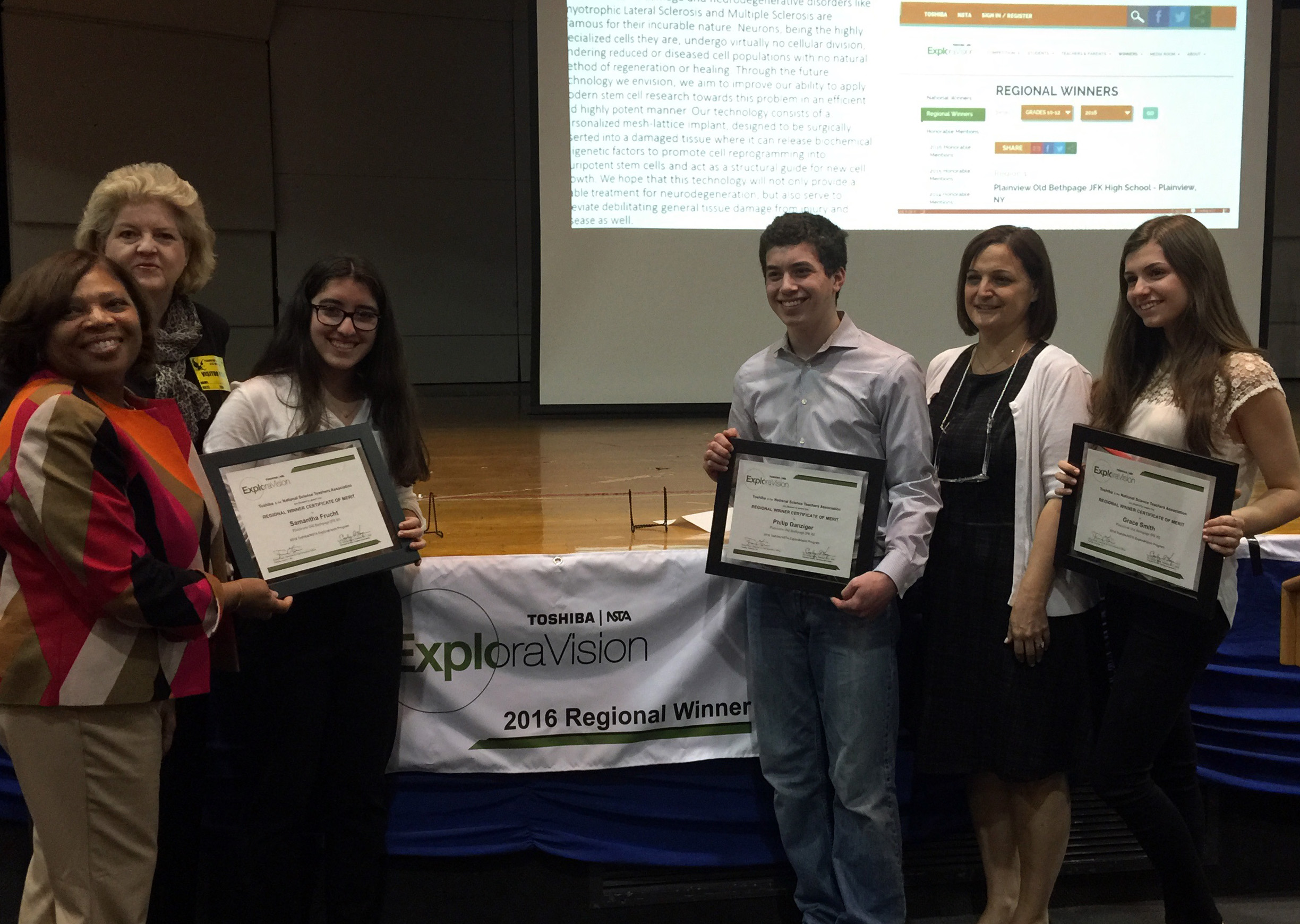
2nd place

Lorna Lewis (District Superintendent), Cindy Johnson (Toshiba), Samantha Frucht, Philip Danziger, Mary Lou O'Donnell (Coach), Grace Smith, Sharon Lasher (Photo credit)
Plainview Old Bethpage JFK HS – Plainview, NY

Intra-Neuromuscular Cellular Regeneration Promoter

Nerve damage and neurodegenerative disorders like Amyotrophic Lateral Sclerosis and Multiple Sclerosis are infamous for their incurable nature. Neurons, being the highly specialized cells as they are, undergo virtually no cellular division, rendering reduced or diseased cell populations with no natural method of regeneration or healing. Through the future technology we envision, we aim to improve our ability to apply modern stem cell research towards this problem in an efficient and highly potent manner. Our technology consists of a personalized mesh lattice implant, designed to be surgically inserted into a damaged tissue where it can release biochemical epigenetic factors to promote cell reprogramming into pluripotent stem cells and act as a structural guide for new cell growth. We hope that this technology will not only provide a viable treatment for neurodegeneration, but also serve to alleviate debilitating general tissue damage from injury and disease as well.

Project website: http://dev.nsta.org/evwebs/4804b/