Unlocking Real-World Skills with ExploraVision
In this series, we’ll hear from teachers and mentors past and present that have guided teams through the Toshiba/NSTA ExploraVision program about the positive impact the program has had on their students.
This year was my first year coaching a team for the Toshiba/NSTA ExploraVision competition, and it turned out to be an incredibly rewarding learning experience for both my students and myself. The competition taught them skills in research, collaboration, and iteration, and showed me how impactful student-led, real-world projects can be in deepening learning.
The 11-Page Research Paper: A Multidisciplinary Experience
The written portion of ExploraVision challenges students to think critically across disciplines. My team tackled a biomedical innovation to treat coronary artery disease (CAD), which led them deep into science, history, analysis, and writing:
- Science: They explored the biology of CAD, its causes, and how various drugs affect plaque buildup. They also investigated the use of iron oxide nanoparticles in biomedical applications.
- History: They studied the evolution of CAD treatments and their impacts on patients, gaining crucial context to inform design decisions.
- Analysis: They evaluated the pros and cons of various methods, considered clinical trials, and assessed their invention’s potential impact.
- Writing: They crafted an 11-page research paper that pushed them to explain complex ideas concisely and cohesively.
Teacher Tip: If you’re working with a lot of students, as I hope to next year, try to partner with other teachers, especially English teachers, to better support the writing and research components.
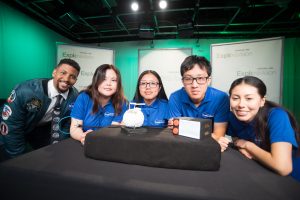

The Website and Video: Real Collaboration in Action
Once my team advanced to the national phase, we were tasked with creating a website and video. While students worked closely and supported each other throughout the process, I was surprised to see roles and leaders emerge based on their interests and skills:
- Lerou handled the website layout and design.
- Hannah built and gathered physical props for the video.
- Ziyang created 3D visualizations of the drug and devices.
- Shelley led the video scripting and editing processes.
Teacher Tip: Let students choose their roles. Have them pitch what they want to lead and why. It builds ownership and naturally balances the workload.
Final Thoughts
Across both phases, iteration was the most important skill my students developed. Every other day during our school-wide 30-minute advisory period, they met in my classroom to receive feedback and revise. Their commitment was so strong that we even continued working during Spring Break! They also sought honest feedback from friends and family, which helped them face flaws, refine their ideas, and grow. Watching their work evolve from “Okay…” to “Oh wow!” was proof that iteration isn’t just part of the process–it’s the key ingredient.
More than just a competition, ExploraVision was a crash course in real-world skills. My students learned to research deeply, collaborate meaningfully, and iterate relentlessly. For me, I learned just how powerful student-led projects can be when they’re given the right structure and support.
To learn more about the 2025-26 ExploraVision program, visit https://www.exploravision.org.